The Short Version
Some walks feel like stepping through a door in time. Down Tor isn’t just a hike — it’s standing where people stood thousands of years ago, looking at the same sky, wondering exactly why they placed these stones, one by one, across the moor.
Also known as Hingston Hill Stone Row, this is one of Dartmoor’s most atmospheric prehistoric sites. Choose a quiet moment and there is plenty of space to pause and take it all in.
The Route
- Start
- Norsworthy Bridge car park, at the eastern end of Burrator Reservoir
- Parking
- Free parking at Norsworthy Bridge.
Open what3words: ///applause.studs.boom - Distance
- Approximately 3 miles there-and-back, depending on your exact route and how much of the row you explore
- Difficulty
- Moderate — open moorland with uneven and sometimes boggy ground
- Ascent
- A steady climb onto the moor; total ascent depends on the route chosen
- Time
- Allow 2–3 hours, including stops and staring in silence
- Grid reference
- SX 5868 6926 — cairn-circle end of the row
- Terrain
- Grassy moor, boggy patches, faint paths and open ground
The Walk
From Norsworthy Bridge, follow the paths uphill towards Down Tor. The approach takes you out onto the open moor, with Burrator behind you and the granite outcrop ahead.
It’s the classic Dartmoor mix: springy turf, hidden damp bits that will find your boots if you’re not paying attention, and the odd patch of gorse to navigate. Nothing brutal in good conditions — just enough to remind you this is proper moorland.
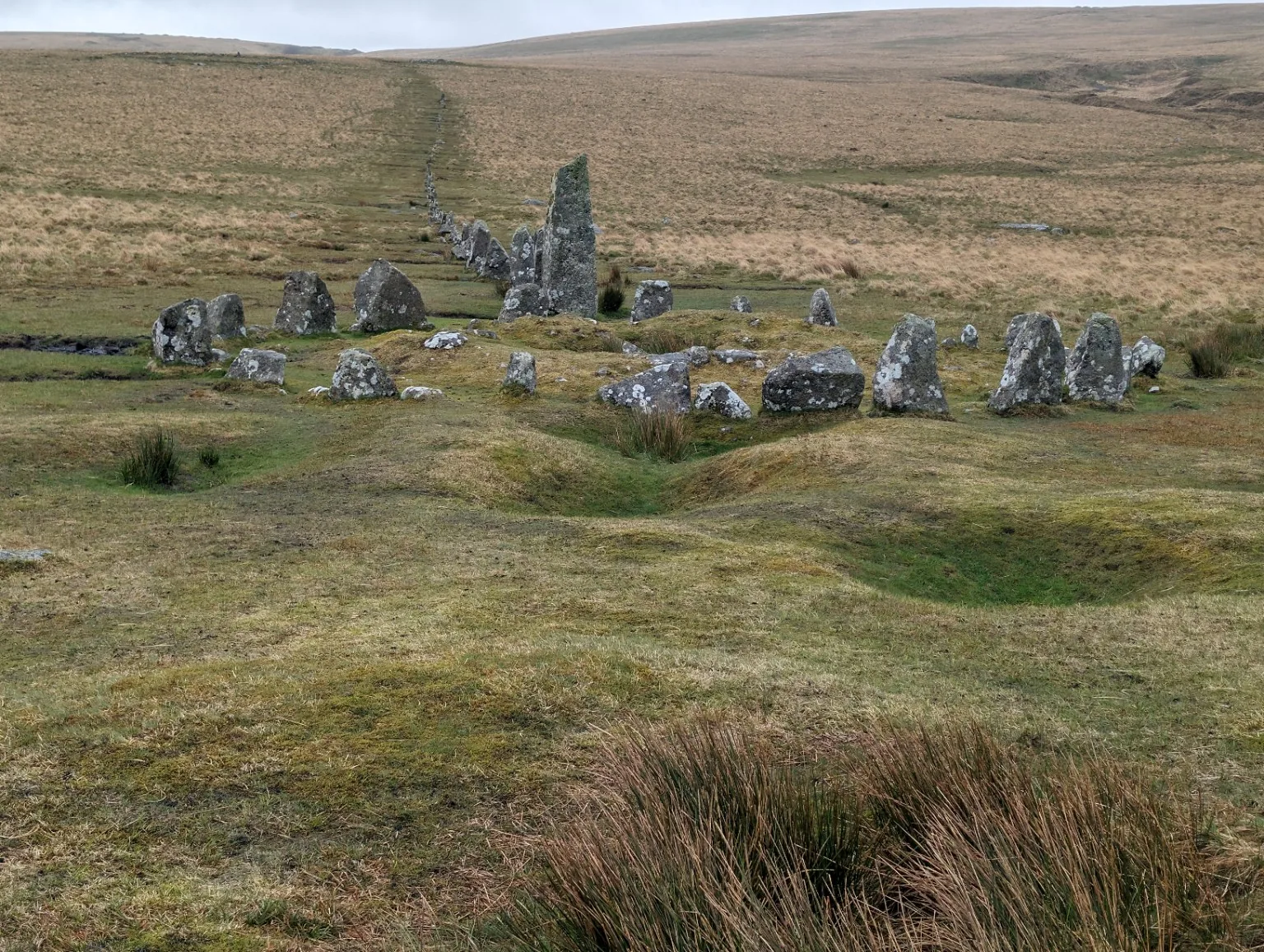
Continue beyond Down Tor towards Hingston Hill to reach the cairn circle and stone row. The stones don’t give themselves away all at once. Then suddenly — there they are.
For the short there-and-back option, return towards Down Tor and retrace your approach to Norsworthy Bridge. This is an overview, rather than a turn-by-turn route: plot your chosen line on a walking map before setting out.
The Stones
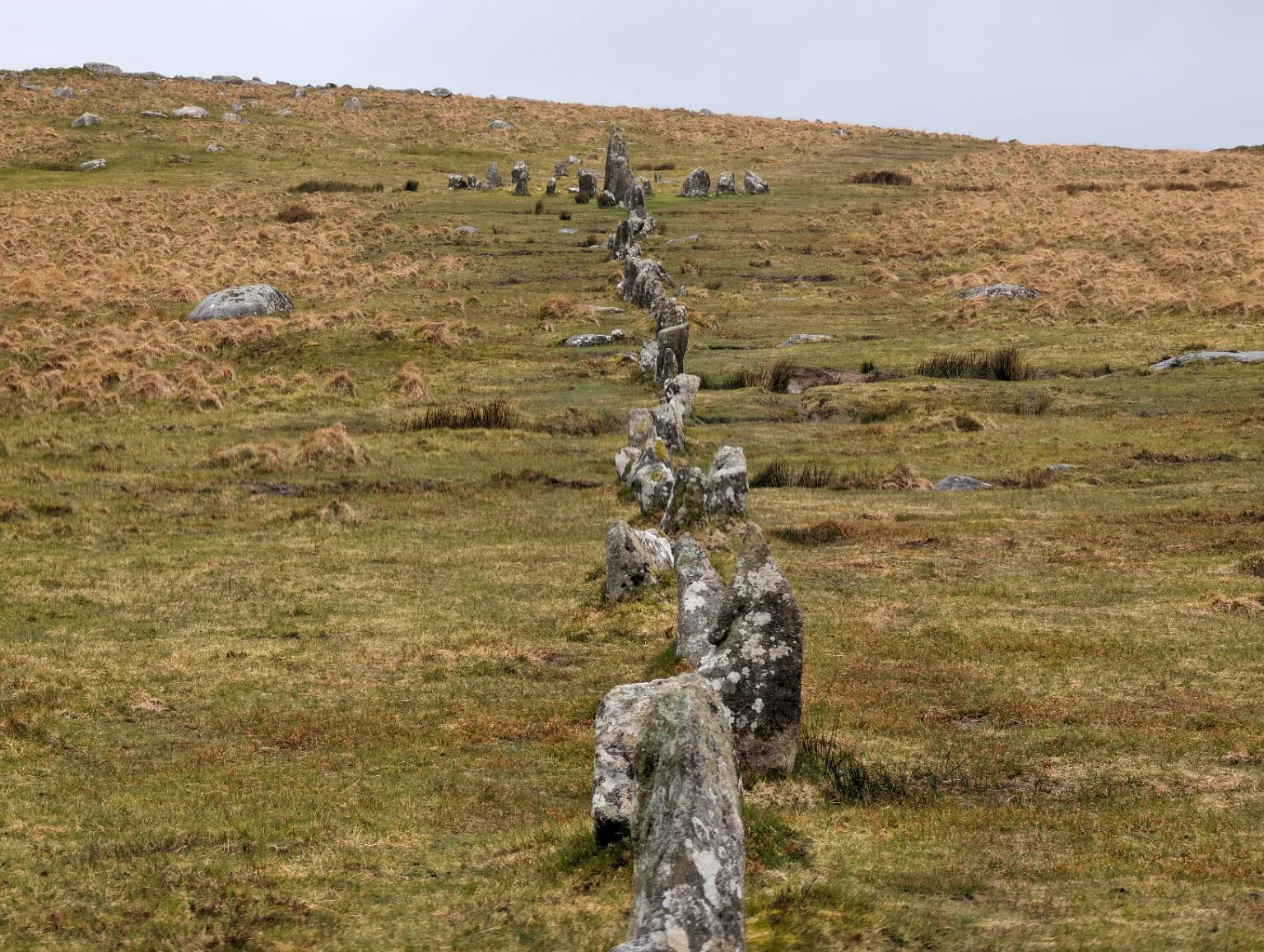
The row stretches away from the cairn circle across the open moor. Historic England records at least 174 stones over 316 metres, with taller stones at both ends. The western standing stone, beside the cairn, reaches about 2.8 metres; the eastern terminal is about 1.6 metres high. Between them, smaller stones give the line its distinctive rhythm.
The cairn has a surrounding ring, or kerb, recorded as 24 upright stones forming a circle about 11.5 metres across. This is a cairn circle associated with a burial monument, rather than a separate stone circle. Its original ceremonies and meanings remain uncertain.
It isn’t perfectly straight, and not every stone has stood untouched: the tall western stone and some others were re-erected in 1890. Historic England places Dartmoor’s stone-row tradition mainly in the Late Neolithic and describes the cairn as Bronze Age. An exact age of 3,500 years would be too definite.
It’s human. It’s ancient. And it’s still here.
The Vibe
No ticket office at the stones. No café queue. Just wind, sky and a landscape with a very long memory.
I stood there for a good while just wondering — who decided this was the place? Who carried the stones? What did this hill mean to them? We may never know the full story, and somehow that makes it more powerful.
The views aren’t bad either: open moorland, distant tors and glimpses towards Burrator along the walk. On a clear day, there is plenty to distract you from watching where you put your boots.
Practical Bits
- Waterproofs and a flask: Dartmoor weather doesn’t read the forecast.
- Navigation: mobile reception can be unreliable. Take a map and compass and know how to use them; download any digital mapping before leaving.
- Bog alert: the ground between the paths and the stones can be soggy. Sturdy footwear helps.
- Leave no trace: this is a scheduled ancient monument. Leave stones where they are, avoid climbing on them and take litter home.
Extra Mile Options
- Include Down Tor’s summit on the way — a worthwhile stop for the views.
- Plan a longer circuit via Combeshead Tor and Cuckoo Rock. Distance and ascent will depend on the paths you choose.
- Make a separate visit to Sheep’s Tor or enjoy a reservoir-side stroll if time and energy allow.
Closing Thought
Places like this remind you that “old” isn’t just a number. It’s people — families, communities, lives — who stood right here and looked out at the moor. Down Tor isn’t just stones. It’s a message across thousands of years. And it’s still waiting for you.
Historical details: Historic England — stone alignment and cairn east of Down Tor. Walking distance and time are approximate.